Root Canal Retreatment: When a Treated Tooth Flares Up Again
Why a treated tooth can become painful years later, what retreatment involves, and how magnification finds what was missed first time.
Finding out that a tooth you had treated years ago is causing trouble again is dispiriting. There is often a sense of having already paid this bill, of having done the responsible thing and been let down by it.
It is worth knowing that this is a recognised situation with an established approach, not an unusual failure. Teeth are complicated, they stay in the mouth for decades after treatment, and a proportion of them will need attention again. This article explains why it happens and what retreatment involves. It is general information only and is not a substitute for an assessment of your particular tooth.
Why a treated tooth can become symptomatic again
Root canal treatment removes the pulp, cleans the canal system and seals it. For that to keep working, the seal has to hold and the canal system has to have been cleaned along its whole length. Several things can undermine that over time.
A canal that was not treated. This is among the more common findings. Canal anatomy varies and some canals are genuinely difficult to locate: a second canal in the mesiobuccal root of an upper first molar is the classic example. If a canal was never found, tissue remains inside it.
A new leak. The restoration on top may have worn, cracked or decayed at its margin, letting bacteria back into the sealed space. This is why the final restoration matters as much as the root canal itself.
Complex anatomy that resisted full cleaning. Sharply curved canals, calcified canals, or connecting isthmuses between canals can be hard to clean completely.
A crack that has developed since. A tooth that has lost structure is more prone to fracture, and a crack that appears later can open a path for bacteria.
Delayed final restoration. A tooth left under a temporary filling for a long stretch is exposed to leakage in the meantime.
None of these mean the original treatment was done badly. Some are simply the nature of the structure being treated.
What the symptoms can look like
Retreatment cases do not always announce themselves with severe pain. Common signs include:
- a dull ache or tenderness when biting on that tooth
- a gum swelling or a small recurring pimple-like spot near the tooth
- a bad taste, or a discharge near the gum line
- discomfort that comes and goes over months
- nothing at all: some are picked up on a routine x-ray
That last one is worth noting. A slowly developing problem at the root tip can be silent for a long time, which is one of the practical arguments for keeping up with check-ups even when nothing hurts. Our article on what happens at a check-up and clean covers what those appointments actually look at.
Where magnification genuinely matters
Retreatment is the situation where a dental operating microscope earns its place most clearly, because the whole task is finding something that was not addressed the first time: an untreated canal, a blockage, a crack, a fractured instrument left in a canal.
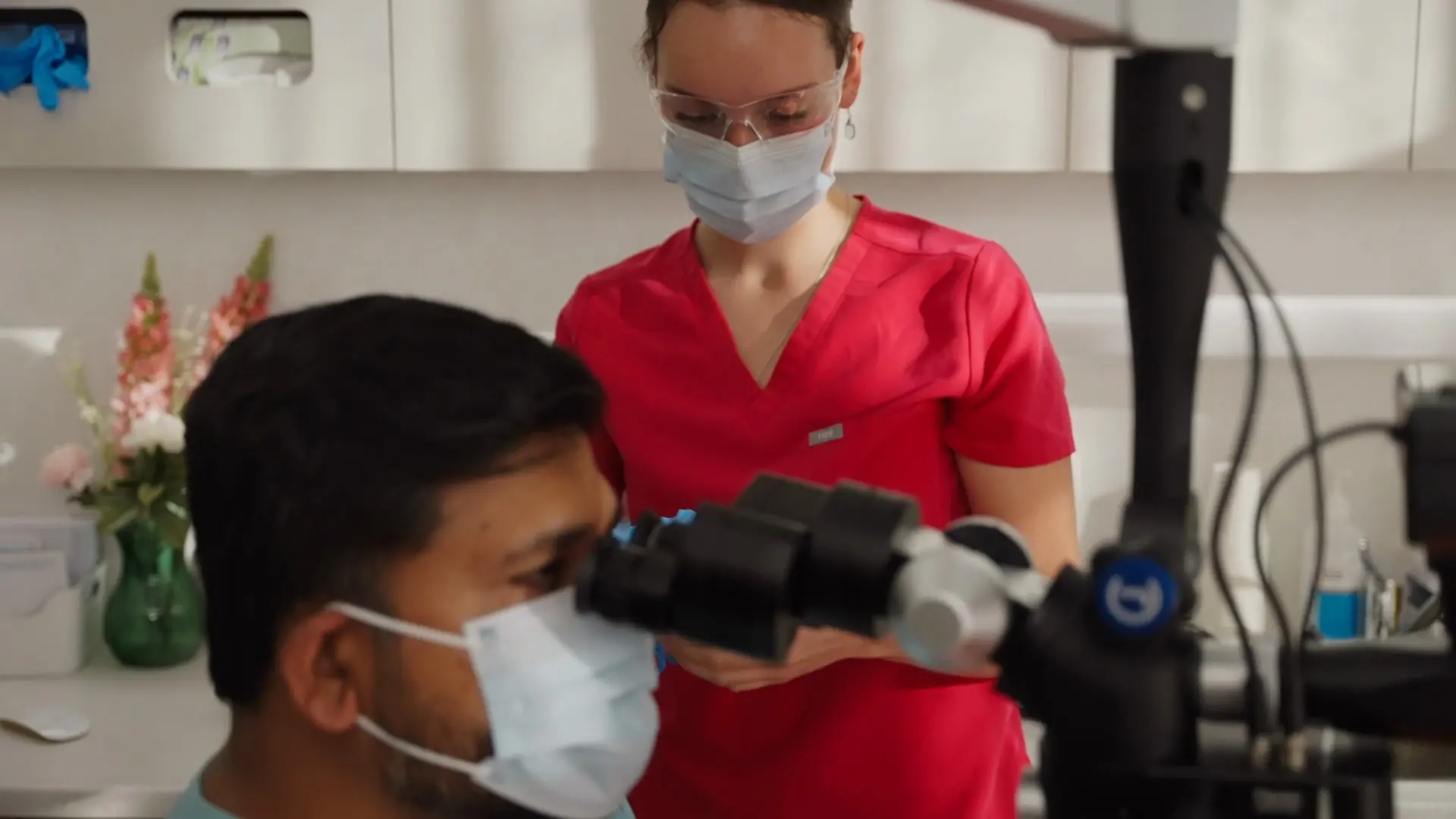
A microscope is a different instrument from magnifying loupes: it is a stand-mounted unit with a much greater magnification range and light delivered along the same optical path as the view, so it illuminates the depth of a canal without the shadow an angled headlight casts. At Dental Embassy in Braddon, Dr Srikanth Karumuri works with a dental operating microscope; its use is case-selected, and in practice most root canal cases are examined microscopically.
Under magnification, a dentist is better placed to identify a canal orifice hidden under a shelf of dentine, to assess how far a previous filling extends, or to see a fine crack in a canal wall. Our article on why dentists use a microscope for root canal treatment goes into what that view shows in more detail.
To be clear about what that does and does not mean: better visibility provides more information for the clinical decision. It is not a guarantee about how any individual tooth will respond.
What retreatment involves
The broad sequence resembles the original treatment with an extra step at the start: removing what is already in there.
- Assessment and imaging. X-rays, and sometimes a 3D scan, to see the existing filling, the root anatomy and any change at the root tip.
- Removing the existing restoration. A crown or filling may need to come off to get access, and it may or may not be reusable afterwards.
- Removing the previous root filling material. This is slow work.
- Locating what was missed. Untreated canals, calcified sections, blockages.
- Cleaning and shaping the full canal system.
- Re-sealing, then a new final restoration.
Retreatment appointments are generally longer than first-time treatment, and more often staged across two or more visits. Our article on how many visits a root canal takes explains what drives that.
When retreatment is not the answer
Retreatment is not always the right path, and an honest assessment sometimes points elsewhere. Factors that count against it include a vertical root fracture, too little sound tooth structure left to restore, or significant loss of bony support around the tooth.
In those situations the discussion turns to removing the tooth and how to handle the gap. Our article on how the root canal or extraction decision gets made covers that reasoning, and our comparison of crown, bridge or implant for a single missing tooth sets out the replacement options.
There is also a surgical option in some cases (a procedure at the root tip rather than through the crown of the tooth) which may be appropriate where retreatment through the tooth is not practical. Whether that applies depends entirely on the individual tooth.
Bringing old dental work with you
People arriving from interstate often have a mixed history of work done in different cities, sometimes decades ago, with no records to hand. That is very common in this catchment: Braddon runs at around 60 per cent renters with a median age of 30, Civic at around 62 per cent with a median age of 27, and Kingston at around 51 per cent, on the 2021 Census. A transient population accumulates dental work in several places.
It is not a problem. A current x-ray shows what is there now, which is what matters. If you do happen to know roughly when the tooth was treated and where, that is useful background, but nobody expects you to produce a file.
Root canal treatment at Dental Embassy
Dental Embassy is on Northbourne Avenue in Braddon, close to Civic and the inner north. If a tooth that has already had root canal treatment is giving you trouble, an assessment of that tooth is the place to start, including whether retreatment is realistic or whether another approach makes more sense.
You can read more on our root canal treatment page, call us on 1300 000 230, or get in touch to arrange a consultation.
Have a question about your own situation?
Book a consultation with the team at Dental Embassy in Braddon. We’ll assess your teeth, explain your options, and answer your questions before anything is decided.