Root Canal or Extraction: How the Decision Gets Made
What decides whether a tooth is worth saving with root canal treatment or is better removed: restorability, cracks, bone support and cost.
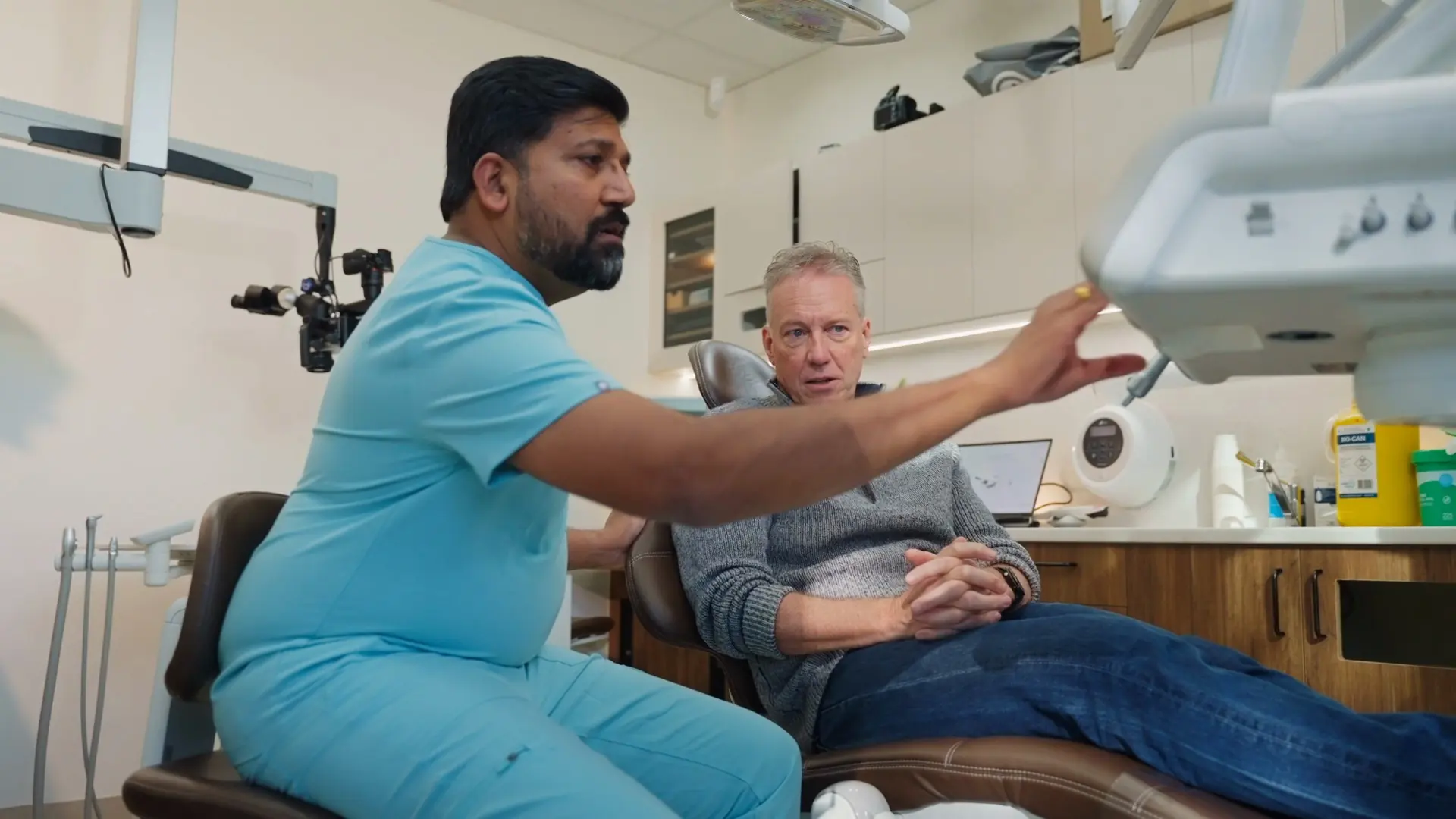
When a tooth has a dying or infected pulp, there are two real options: treat the inside of the tooth and keep it, or take the tooth out. People often expect this to be a straightforward call, and are surprised when the answer is genuinely a discussion.
Sometimes the tooth decides for itself: it is too broken down or too badly cracked, and there is nothing to keep. Often, though, it is a judgement that weighs several factors together. This article sets out what those factors are, so the conversation makes more sense when you are having it. It is general information only and is not a substitute for an assessment of your particular tooth.
The starting position: keeping a tooth is usually preferable
Natural teeth are worth keeping where it is sensible to keep them. A tooth sits in bone, maintains that bone, holds its neighbours in position, and does a job that no replacement does in exactly the same way. Removing one sets off a sequence: the gap either gets filled (with an implant, a bridge or a denture) or it does not, and the teeth around it gradually respond to the space.
That is the default, not an absolute rule. A tooth kept at all costs, that then fails in two years, may leave you worse off than a tooth removed cleanly at the start.
What makes a tooth restorable
This is usually the deciding factor, and it has little to do with the root canal itself. The question is whether enough sound tooth structure remains above the gum to build a lasting restoration on.
A root-canal-treated tooth generally needs a substantial restoration afterwards (often a crown), and a crown needs something to hold onto. If decay or an old fracture has taken the tooth down close to gum level, there may not be enough left to grip. Sometimes that can be worked around; sometimes it cannot.
Related considerations include:
- Cracks. A crack confined to the crown of the tooth may be manageable. One running down into the root, particularly a vertical root fracture, generally is not.
- Bone support. If gum disease has already cost the tooth much of its bony support, saving the pulp is beside the point.
- How much of the tooth wall is left. A tooth with all four walls intact behaves very differently from one with a single remaining wall.
- The tooth’s position and job. A molar taking heavy chewing load faces different forces from a front tooth.
Cracks are the common surprise
The most frequent reason a plan changes partway through is a crack that was not visible at the outset. Fine cracks do not always show on an x-ray, and they are easy to miss with the naked eye inside a tooth.
This is one of the situations where magnification matters. Working under a dental operating microscope, as Dr Srikanth Karumuri does for most root canal cases at our Braddon practice, makes it more likely that a crack in a canal wall is identified, and identified before rather than after time and money have gone into treating the tooth. Our article on why dentists use a microscope for root canal treatment explains more about what that view shows.
Finding a crack is not a good outcome, but finding it early is a much better outcome than finding it late.
Thinking about cost honestly
Cost is a legitimate part of this decision and pretending otherwise is not helpful. What is worth avoiding is comparing the wrong numbers.
An extraction on its own is generally less expensive than root canal treatment plus a crown. But an extraction usually is not the end of the matter: the gap normally needs to be addressed, and implants, bridges and dentures each carry their own cost and their own timeline. Comparing “extraction” against “root canal plus crown” understates the extraction pathway unless you include what follows it.
There is also the option of leaving the gap, which is sometimes reasonable (for a wisdom tooth, or occasionally a second molar) and sometimes stores up problems.
We do not publish prices for this in the abstract, because the figures depend entirely on the tooth. What we can do is set out the factors involved, and our articles on what affects the cost of dental implants in Canberra and the options for replacing a missing tooth cover the replacement side. The fees page explains how we handle estimates.
What replacing the tooth would involve
If extraction is the direction, it is worth understanding the replacement options before the tooth comes out rather than afterwards, because some choices are easier to make in advance.
Broadly, the options are an implant, a bridge, a denture, or accepting the gap. Each suits different situations, and factors such as the neighbouring teeth, the available bone and the timeline all feed in. Our comparison of crown, bridge or implant for a single missing tooth goes through the trade-offs, and the dental implants page explains that pathway in more detail.
Timing, and why waiting rarely helps
One thing worth saying plainly: a tooth with an infected pulp does not stabilise on its own. Pain may come and go (sometimes it stops entirely when the pulp dies, which is easily mistaken for improvement), but the underlying infection continues.
What waiting tends to do is narrow the options. A tooth that was restorable can become unrestorable; a straightforward extraction can become a more complicated one. If the aim is to keep the tooth, time is generally not on your side.
This particular pattern turns up often in the inner north, where the catchment is young and transient. Braddon’s median age is 30 and around 60 per cent of households rent, and Civic’s median age is 27 with a similar rental profile, on the 2021 Census. People who have recently moved to Canberra frequently have no local dentist yet, so a tooth that flared up months ago gets managed with painkillers instead of an appointment. In the more settled suburbs like Ainslie, where the median age is 42, the more common version is a heavily filled tooth from decades ago that has finally reached the end of what it can take.
Root canal treatment at Dental Embassy
Dental Embassy is on Northbourne Avenue in Braddon, close to Civic and the inner-north suburbs. If you are weighing up whether to save or remove a tooth, an assessment of that specific tooth, including whether it is restorable, is where the decision properly starts.
You can read more on our root canal treatment page, call us on 1300 000 230, or get in touch to arrange a consultation.
Have a question about your own situation?
Book a consultation with the team at Dental Embassy in Braddon. We’ll assess your teeth, explain your options, and answer your questions before anything is decided.