When a Tooth Needs a Crown Instead of a Filling
How dentists decide between a filling and a crown: how much tooth is left, cracks, root-canal-treated teeth and heavy chewing load.
Being told a tooth needs a crown rather than a filling often prompts a reasonable question: is that really necessary, or is it the more expensive option being suggested for its own sake?
It is a fair thing to wonder, and it deserves a proper answer rather than a defensive one. There is a real clinical logic to when a filling is enough and when it is not, and once you understand it you are in a much better position to ask useful questions. This article explains that reasoning. It is general information only and is not a substitute for an assessment of your particular tooth.
The difference in what they do
A filling replaces missing tooth structure from the inside. Material is placed into the space where decay or an old filling was, and it is supported by the walls of tooth around it.
A crown works the opposite way. It covers the tooth from the outside, wrapping over the biting surface and around the walls, holding the remaining structure together and taking the chewing load itself.
That difference explains almost everything about when each is used. A filling relies on the tooth’s own walls being strong enough. A crown is what you use when they are not.
How much tooth is left
This is the main factor. A back tooth has walls (the cusps you can feel with your tongue) and their job is to withstand chewing forces. Every time a tooth is filled, some of that structure is replaced by material that does not bond to it in the same way natural tooth is joined to itself.
Broadly: a small or moderate cavity with plenty of surrounding structure is filling territory. A tooth where a large old filling occupies most of the biting surface, leaving thin walls standing around it, is a different situation: those thin walls are vulnerable to fracturing under load, often at the worst moment and sometimes below the gum line, where the tooth becomes much harder to save.
The judgement is essentially about whether the remaining structure can carry the load, or whether it needs something to carry the load for it.
Cracks
Cracked teeth are a common reason for a crown. A tooth with a crack running through it can flex slightly under chewing pressure, which produces that distinctive sharp twinge on biting or on releasing a bite, often intermittent, often hard to pin down to a specific tooth.
A filling does not resolve this, because it does not stop the flexing. A crown holds the tooth together and prevents the movement that causes both the symptom and the risk of the crack extending.
Not every crack is treatable this way. A crack that has already extended into the root generally cannot be saved by covering the tooth, which is part of why an assessment matters before committing.
After root canal treatment
Teeth that have had root canal treatment usually need a crown, particularly molars and premolars.
The reason is structural rather than anything to do with the treatment itself. It is a common belief that root canal treatment makes a tooth brittle; the evidence does not support that. What does matter is how much sound tooth is left: such a tooth has usually lost structure twice over, first to the decay or crack that killed the pulp, then to the access opening made through the biting surface. Less structure holding it together means it is more likely to fracture under normal chewing forces.
The final restoration is genuinely part of the treatment, not an optional extra afterwards. A well-cleaned root canal in a tooth that then splits has not achieved much. Our walkthrough of what happens during a root canal puts this stage in sequence, and the root canal treatment page covers the treatment itself.
What a crown appointment involves
The usual sequence is:
- Preparation. The tooth is shaped to make room for the crown, and any decay or failing old filling is removed. Sometimes a core build-up is needed first to give the crown something solid to sit on.
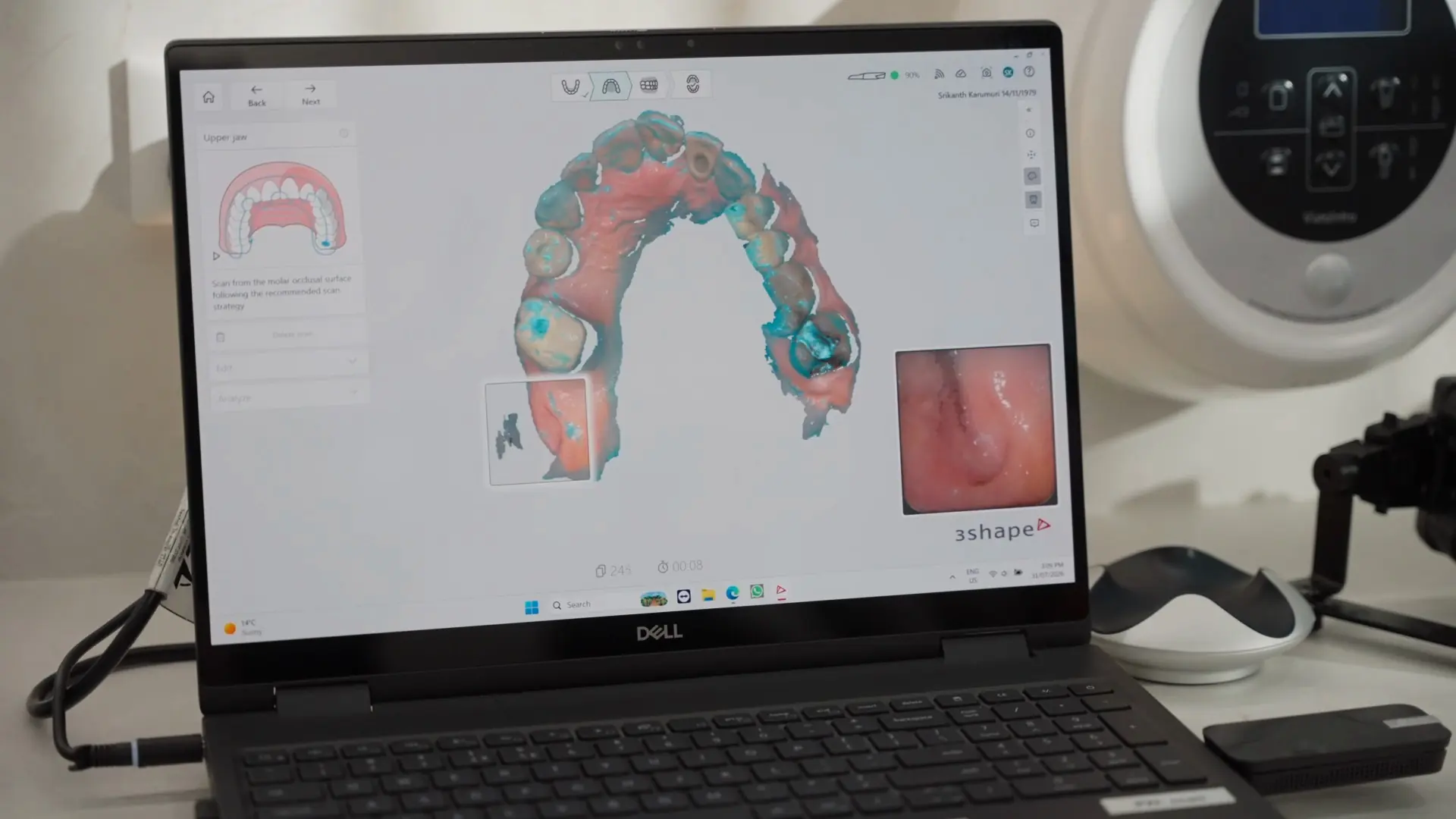
- A scan or impression. A digital scan or a physical impression records the shape of the prepared tooth and how it meets the teeth around and opposite it.
- A temporary crown. This protects the tooth while the permanent one is made.
- Fitting. The finished crown is tried in, the fit and bite are checked and adjusted, and it is cemented.
Crowns are made in different materials, and which suits your tooth depends on where it sits, how much clearance there is, and the forces it takes. That is a conversation to have about your specific tooth rather than a decision to make in advance. The crowns and bridges page sets out what we offer.
Where fit matters
A crown has a margin (the join between the crown and the tooth) and that join is where problems tend to begin years later. A margin that is not well adapted gives plaque somewhere to accumulate at the gum line and can allow decay to start underneath, where it is difficult to detect.
Assessing margins is fine detail work, which is why magnification is used in this part of dentistry as well as in root canal treatment. Dr Srikanth Karumuri works with a dental operating microscope at our Braddon practice.
Questions worth asking
If a crown is recommended and you want to understand the reasoning, these tend to be productive:
- How much sound tooth structure is left, and where?
- Is there a crack, and if so, how far does it appear to extend?
- What happens if we place a large filling instead: what is the realistic risk?
- Does this tooth need anything else first, such as root canal treatment?
- How long is this likely to last, and what affects that?
That last one is worth reading alongside our article on how long crowns last and what affects it.
The cost question
Crowns cost more than fillings, and that is often what sits behind the hesitation. The useful comparison is not simply the two prices, though. It is the two pathways. A large filling in a heavily broken-down tooth that fractures in eighteen months can lead to a more complicated and more expensive situation than the crown would have been.
That is a reason to understand the reasoning, not a reason to be pushed. If the honest answer is that a filling is reasonable and a crown is the more cautious option, that should be said plainly so you can decide. Our fees page explains how we handle estimates.
Crowns at Dental Embassy
Dental Embassy is on Northbourne Avenue in Braddon, a short walk or light rail trip from Civic and the inner-north suburbs. If you have been told a tooth needs a crown and would like to understand why, or want a considered look at a tooth that keeps twinging when you bite, an assessment is the place to start.
You can read more on our crowns and bridges page, call us on 1300 000 230, or get in touch to arrange a consultation.
Have a question about your own situation?
Book a consultation with the team at Dental Embassy in Braddon. We’ll assess your teeth, explain your options, and answer your questions before anything is decided.