Dentures, Implants or Implant-Retained Dentures
How conventional dentures, individual implants and implant-retained dentures differ: what each involves and what decides between them.
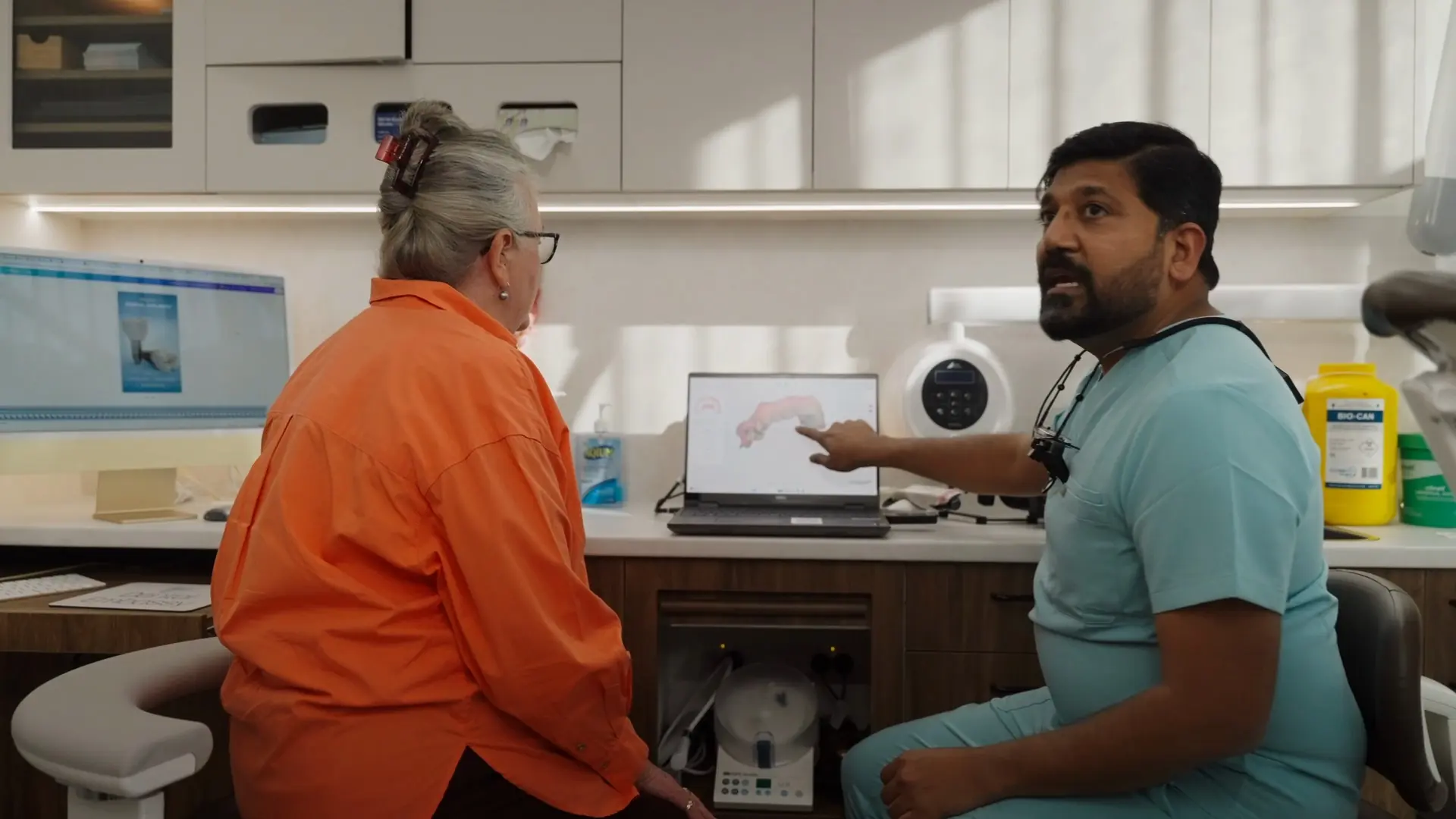
When several teeth are missing, or a whole arch, the options divide into three broad approaches rather than two. The middle one (an implant-retained denture) is the least well known, and it is often the one that fits people who have struggled with a conventional lower denture.
This article explains how the three compare. It is general information only and is not a substitute for an assessment of your situation, since what suits you depends on the bone you have, the teeth you still have, and what you want out of it.
Conventional dentures
A removable prosthesis that rests on the gum and ridge. An upper full denture covers the palate and gets a useful degree of suction from that coverage. A partial denture clasps onto your remaining natural teeth.
Where it works well: it is the least expensive route, it needs no surgery, it can replace many teeth at once, and it can usually be provided relatively quickly. For an upper arch in particular, a well-made conventional denture performs better than most people expect.
Where it struggles: the lower arch. There is no palate to create suction, the tongue is active, and the ridge available to sit on is smaller. Lower full dentures are the ones people most often describe as moving when they eat or talk. Our article on full and partial dentures covers both types in more detail, and getting used to new dentures deals with the adjustment period.
Individual implants
An implant replaces a single tooth root: a post placed in the bone, left to integrate over some months, then restored with a crown. Several implants can also support a fixed bridge across a span.
Where it works well: it is fixed, nothing comes out, it is cleaned like a natural tooth, and it does not rely on the teeth either side. For one missing tooth or a short span it is often the most satisfactory answer.
Where it struggles: replacing a full arch this way means a large number of implants and a correspondingly large cost. It also depends on having adequate bone, on general health and healing, and on a timeline measured in months rather than weeks.
Our comparison of crown, bridge or implant for a single missing tooth covers the single-tooth decision, and the dental implants page explains the process.
Implant-retained dentures
This is the middle path, and it is genuinely different from both. A small number of implants (usually two to four for a lower denture, and around four for an upper) are placed in the jaw, and the denture clips onto them.
The denture is still removable. You take it out to clean it and overnight, as you would a conventional one. But while it is in, it is anchored rather than resting loose on the ridge.
Where it works well:
- It addresses the specific problem conventional lower dentures have. Anchoring is what a lower denture lacks, and this supplies it.
- It uses far fewer implants than replacing every tooth individually, so the cost sits between the two other approaches.
- An upper implant-retained denture can sometimes be made with less palatal coverage, which some people find improves how food tastes.
- The implants stimulate the bone in the areas where they sit, which a conventional denture does not do.
What to weigh:
- It still involves implant surgery and the healing time that goes with it.
- It depends on there being adequate bone in the right places; if there is not, grafting may be needed first.
- The clip attachments wear over time and need replacing periodically, a small ongoing maintenance item rather than a one-off.
- It is still a denture. It comes out, and it still needs the cleaning routine that goes with one.
The dentures page sets out what is involved.
One thing we do not offer
We should be straightforward about a boundary. We do not offer All-on-4: the approach where a fixed full-arch bridge is secured on four implants and is not removable by the patient.
Implant-retained dentures are a different thing, despite sometimes being confused with it. The denture clips on and comes out for cleaning; an All-on-4 bridge stays in and is cleaned in place. If All-on-4 is what you are specifically after, that is a conversation to have with a practice that provides it.
What tends to decide it
- Which arch. Lower arch difficulties are the single most common reason people look past a conventional denture.
- Bone. How much there is, and where. This is assessed with a 3D scan.
- Budget. The three approaches sit at genuinely different levels, and it is reasonable to say so plainly.
- Timeline. Conventional dentures are the quickest; anything involving implants takes months.
- General health and healing. These affect implant treatment more than they affect a conventional denture.
- What you actually want. Some people are content with a conventional denture and want the least intervention. Others find the movement of a lower denture the thing they most want solved. Both are legitimate starting points.
There is also a sequencing option worth knowing about: a conventional denture now, with implants added later to anchor it. That is not always possible and depends on how the denture is made, but it is worth asking about if cost or timing is the obstacle right now.
Around the catchment
This conversation comes up most in the older, more settled parts of the catchment: the arc through Ainslie, Deakin, Yarralumla, Red Hill and Forrest, where median ages run from 42 to 50 on the 2021 Census, and Hackett and Narrabundah at around 40.
Practically, any implant pathway involves several appointments spread over months. We are on Northbourne Avenue in Braddon with light rail at the door, and open from 7:30am on weekdays and 9:00am to 3:00pm on Saturdays, which makes a long sequence of visits easier to fit around everything else.
Sedation is available for the surgical stages if that is a concern. Options are explained on our sedation dentistry page, with IV sedation provided at the practice by our sedationist Dr Anna Huang.
Dentures and implants at Dental Embassy
Dental Embassy is on Northbourne Avenue in Braddon, close to Civic and the inner north. If you are weighing up how to replace several missing teeth, an assessment, including a 3D scan where implants are being considered, is what turns a general comparison into a specific recommendation.
You can read more on our dentures page or dental implants page, call us on 1300 000 230, or get in touch to arrange a consultation.
Have a question about your own situation?
Book a consultation with the team at Dental Embassy in Braddon. We’ll assess your teeth, explain your options, and answer your questions before anything is decided.