Full or Partial Dentures: Which Applies to You
The difference between full and partial dentures, how each is held in place, and the practical factors that shape which suits you.
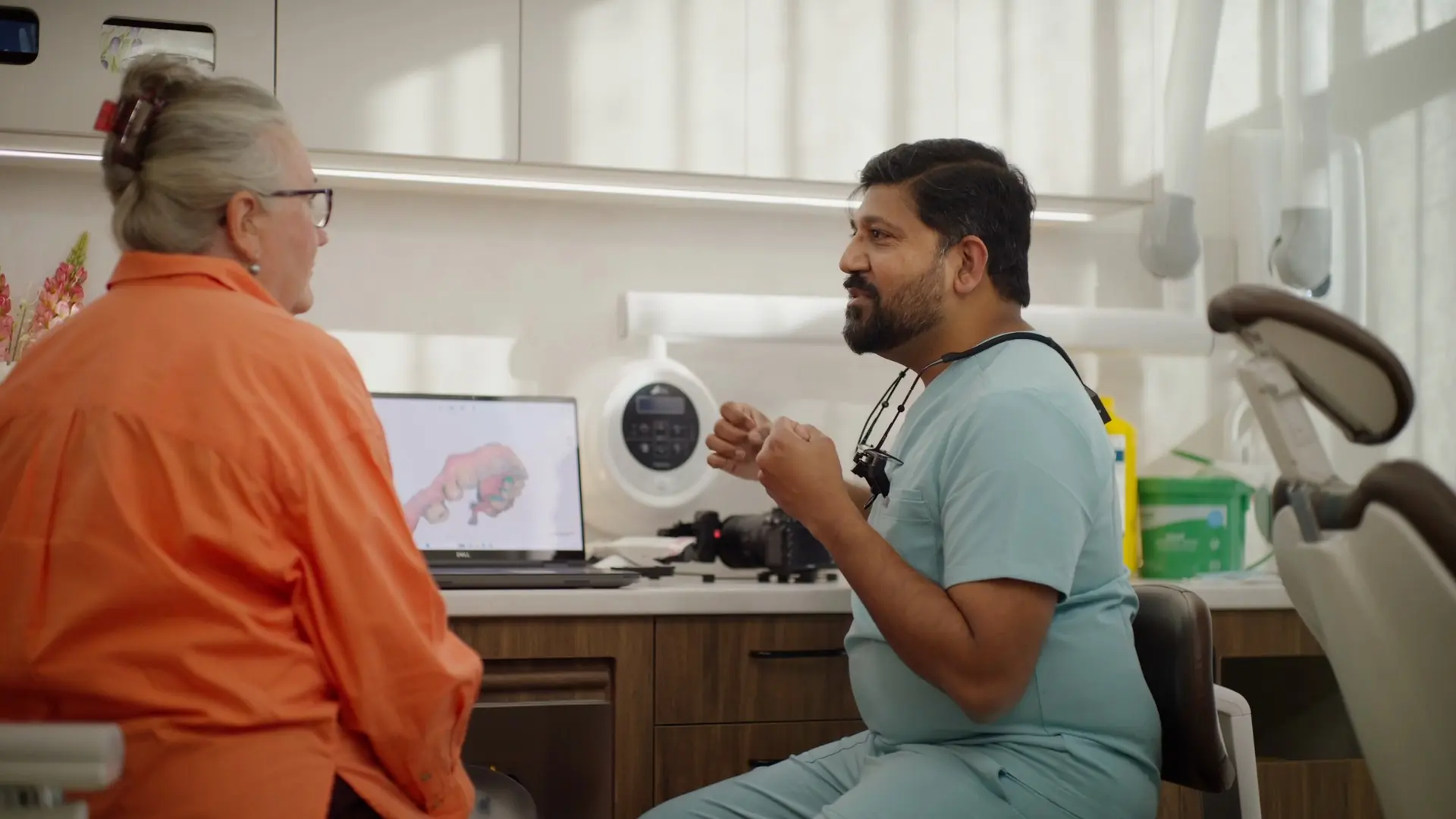
Dentures are one of the few dental treatments people arrive already knowing something about, usually through a parent or grandparent. That inherited picture is often a few decades out of date, and it tends to come with an assumption that dentures are an all-or-nothing proposition.
They are not. This article sets out what the actual options are and what shapes the choice between them. It is general information only and is not a substitute for an assessment of your situation.
Partial dentures: filling gaps around existing teeth
A partial denture replaces some missing teeth while your remaining natural teeth stay in place. It is removable, and it is held in position by resting against and clasping onto the teeth that remain.
They are made in a few different forms:
Acrylic partials are made largely of pink acrylic that sits over the gum and palate, with the false teeth set into it. They are the least expensive option, they can be added to if more teeth are lost later, and they are often used as a temporary or interim measure. The trade-off is bulk: more material covering more of the mouth.
Cast metal partials use a slim cobalt-chromium framework. They are thinner, stronger, cover less of the palate, and transmit temperature better so food tastes more normal. They cost more and are harder to modify afterwards. For a long-term partial denture, most people find the difference in comfort worth it.
Flexible partials use a pliable material and are sometimes used for small spans. Whether they suit depends on the case.
The main point about partials is that they depend on your remaining teeth. Those teeth take extra load, and they need to stay healthy, so cleaning around the clasps and keeping up with check-ups matters more, not less, once you have one.
Full dentures: replacing a whole arch
A full denture replaces all the teeth in the upper jaw, the lower jaw, or both.
An upper full denture covers the palate, and that coverage generates a degree of suction that helps hold it in place. Most people adapt to it, though it does reduce the sensation of temperature and texture from the roof of the mouth.
A lower full denture is the more difficult one, and it is worth being honest about that up front. There is no palate to create suction, the tongue is active and tends to dislodge it, and there is less ridge to sit on. Lower dentures generally take more adjustment and more patience than upper ones. People are often surprised by this, having expected the two to behave similarly.
Immediate dentures
An immediate denture is made in advance and fitted on the same day teeth are removed, so you do not go without.
The advantage is obvious. The trade-off is that the gum and bone change shape considerably as they heal over the following months, so an immediate denture will need relining or remaking once things settle. That is expected and planned for, not a fault, but it should be understood as part of the cost and the timeline rather than a surprise later. Our article on denture repairs and relines covers what relining involves.
What tends to decide it
- How many teeth remain, and their condition. A partial denture needs healthy teeth to anchor to. Teeth that are failing may not be a sound foundation.
- Where the gaps are. Gaps distributed on both sides of an arch are generally more stable to work with than a single free-end gap at the back.
- Gum and bone health. This affects both fit and long-term stability.
- Your bite. How the arches meet affects the forces a denture will experience.
- Timeline and budget. An acrylic partial is quicker and less expensive; a cast metal one takes longer and costs more.
- What you want to be able to eat. Worth being specific about, because it is often the thing that matters most day to day.
The other options
Dentures are not the only route, and they should be compared honestly against the alternatives.
For a single missing tooth, a bridge or an implant is usually a better answer than a partial denture, because both are fixed. Our comparison of crown, bridge or implant for a single missing tooth sets out that reasoning, and our article on options for replacing a missing tooth covers the wider picture.
For larger spans, dentures often remain the practical answer, particularly where several teeth are missing across an arch or where bone loss limits other options.
One boundary worth stating: we do not offer All-on-4. We do offer implant-retained dentures, where two to four implants anchor the denture so it clips firmly into place, covered on our dentures page, alongside single implants and implant-supported bridges, set out on our dental implants page.
The adjustment nobody warns you about
Whatever type you end up with, the first weeks involve real adjustment: to speech, to eating, and to the physical sensation of something in your mouth that was not there before. It is normal for this to feel discouraging at first and to improve steadily.
Our article on getting used to new dentures covers that period in detail, because it is the part people are least prepared for and the part where most of the difficulty sits.
Around the catchment
Dentures come up most in the older, more settled parts of the catchment: the arc through Ainslie, Deakin, Yarralumla, Red Hill and Forrest, where median ages run from 42 to 50 on the 2021 Census, and Hackett and Narrabundah at around 40.
Practical detail: we are on Northbourne Avenue in Braddon with light rail at the door, which matters for a treatment that involves several appointments over a few months. Denture work is not a single visit, and being able to get in without driving and parking each time makes the sequence easier.
Dentures at Dental Embassy
Dental Embassy is on Northbourne Avenue in Braddon, close to Civic and the inner north. If you are missing teeth, or facing the loss of some, an assessment of what remains and what your options actually are is the sensible place to start.
You can read more on our dentures page, call us on 1300 000 230, or get in touch to arrange a consultation.
Have a question about your own situation?
Book a consultation with the team at Dental Embassy in Braddon. We’ll assess your teeth, explain your options, and answer your questions before anything is decided.