Small Changes, Not a Makeover
Why the least irreversible treatment that addresses your concern is usually the better starting point in cosmetic dentistry, and how to tell.
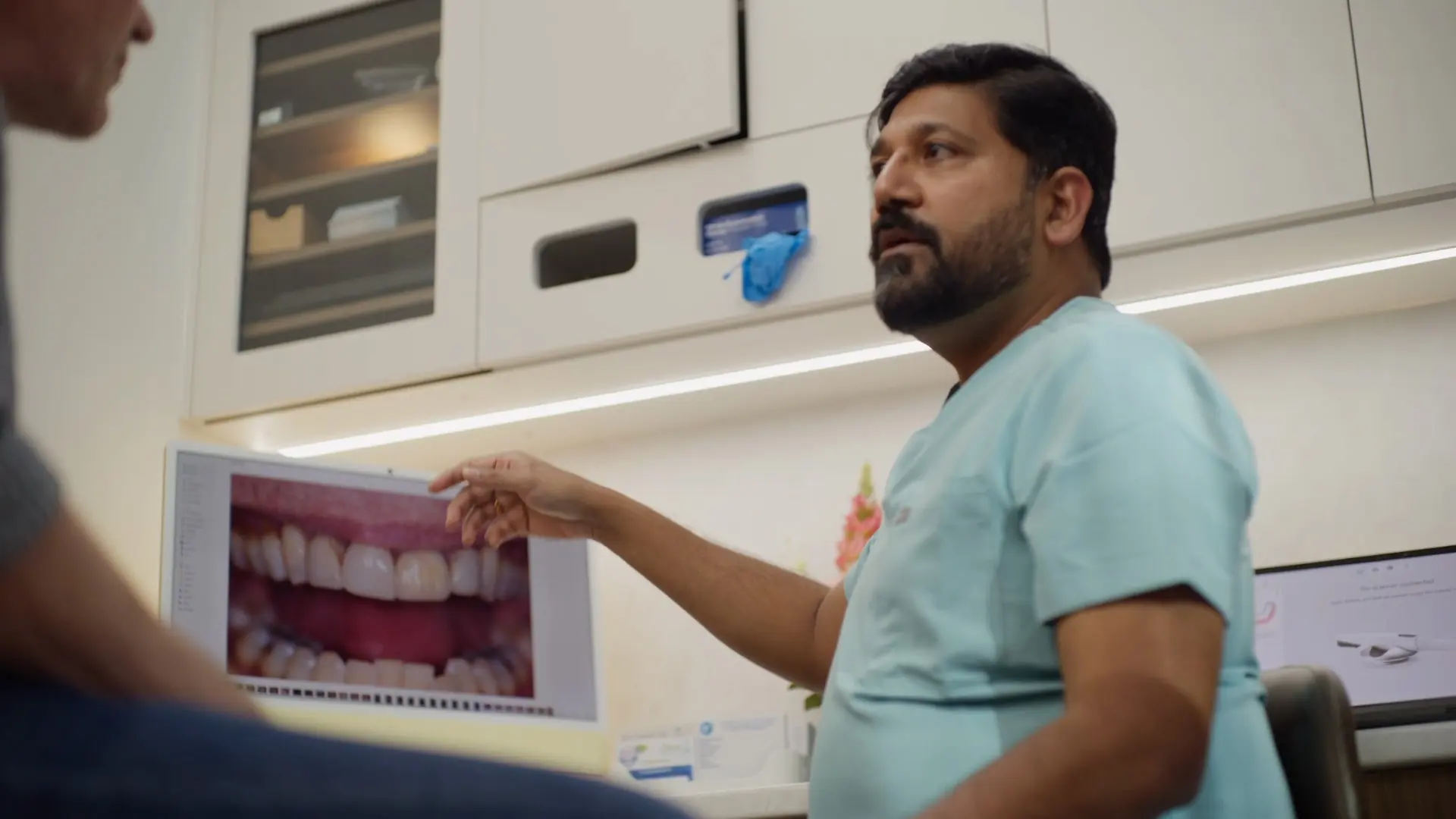
There is a particular conversation that happens often enough to be worth writing about. Someone comes in bothered by one thing (a chipped edge, a tooth that sits slightly behind the others, a filling gone grey at the margin) and leaves having been quoted for ten veneers.
Sometimes a comprehensive plan is genuinely the right answer. Often it is not, and the person has simply been moved from the problem they arrived with to a much larger one. This article is about how we think about that. It is general information only and is not a substitute for a consultation.
Start with the actual complaint
The first useful step is getting specific. “I don’t like my smile” is a feeling, not a brief, and treating it as a brief tends to lead somewhere expensive.
Pressed gently, most people can identify something concrete: it is the colour, or the one tooth that catches the light oddly, or the way the edges have worn unevenly, or the gap that has slowly opened. Once it is named, it can be addressed, often far more simply than the general dissatisfaction suggested.
Occasionally the honest finding is that the specific thing is not what is bothering the person, and no dental treatment is going to resolve it. That is worth saying too.
The principle: least irreversible first
Dental treatments differ enormously in how much they commit you to.
- Whitening removes nothing. It fades and can be repeated or abandoned.
- Bonding adds material and usually removes little or no healthy tooth. It can be polished off.
- Aligners move teeth and usually remove little or no structure, though creating room for crowded teeth often involves small amounts of enamel reduction between them, which does not grow back either.
- Veneers require permanent enamel removal. Enamel does not grow back, and a prepared tooth will generally need a veneer or crown from then on.
- Crowns remove more still.
None of these is better in the abstract. A crown is exactly right for a heavily broken-down tooth, and bonding would be a poor answer there. The principle is simply that where two options would address the concern, the one that keeps your options open is usually the better place to begin, particularly for someone in their twenties or thirties who will live with the decision for decades.
Canberra’s inner north skews young: Braddon has a median age of 30, Turner 31, Civic 27, and Acton (largely the ANU population), 19, on the 2021 Census. A permanent decision made at 24 has a long time to be lived with.
What a considered plan looks like
Signs that a plan has been thought about properly:
- Health comes first. Decay, gum disease and failing restorations are dealt with before any cosmetic work.
- The cause of wear is investigated. Worn front edges have a reason: grinding, an uneven bite, dietary acid. Restoring the appearance without addressing the cause invites a repeat.
- The number of teeth is justified. If a plan covers eight teeth, there should be a reason for each. Sometimes matching genuinely requires a wider span; sometimes it is scope creep.
- Alternatives are named. Including cheaper and more conservative ones, and including doing nothing.
- What is permanent is stated plainly. How much enamel comes off, from which teeth.
- You are not asked to decide on the day.
What less considered advice tends to look like
- A number of veneers quoted before your teeth have been examined in detail
- Crowding proposed to be solved with veneers rather than by moving the teeth
- Whitening scheduled after the new work rather than before it: dental work does not lighten, so the sequence matters
- Time pressure, or a discount that expires
- Galleries of other patients’ before-and-after photographs
That last one is worth knowing about specifically. Dental advertising in Australia is regulated under the National Law. Patient testimonials are prohibited outright, and before-and-after images are treated as high risk: where they are used at all they must carry a clear warning that results vary, must not be digitally altered, and must be genuinely comparable in angle, lighting and framing. A gallery presented as a straightforward promise of what you will get is worth treating with caution.
Sequence, not scale
A useful reframing: cosmetic dentistry does not have to happen all at once.
Whitening can be done, and lived with, before deciding whether anything else is needed. Quite often it settles the matter. If not, a single bonded repair can be added and assessed. Larger work remains available later if it turns out to be warranted.
Staged this way, each step informs the next and nothing irreversible happens before it is clearly justified. The main argument against staging is matching (porcelain made at different times can be harder to match), which is a real consideration for adjacent front teeth, and much less of one across a whole plan.
The honest limits
Some things dentistry does well and some it does not.
Colour responds well to whitening, though how much varies between people and the change is not permanent. Small chips and edges are readily improved. Position is best addressed by moving teeth. Some concerns (the amount of gum showing when you smile, the shape of the lip, facial asymmetry) are only partly dental, and it is better to know that at the start than after treatment.
Where a hoped-for result is not achievable, we would rather say so. It is a less appealing conversation than an optimistic one, and it is more useful.
What to bring to a first appointment
You do not need to arrive with a treatment in mind. What helps:
- the specific thing that bothers you, described as precisely as you can
- when you notice it: photographs, particular lighting, particular company
- whether you grind your teeth or wake with a tight jaw
- what you would be comfortable committing to, and what you would not
- your honest budget, which shapes sequence more than it limits options
Cosmetic dentistry at Dental Embassy
Dental Embassy is on Northbourne Avenue in Braddon, a short walk or light rail trip from Civic and the inner north. If something has been bothering you, we are happy to look at it and talk through what is realistic, including when the simplest option is the right one.
You can read more on our cosmetic dentistry page, our comparison of veneers, bonding and whitening, call us on 1300 000 230, or get in touch to arrange a consultation.
Have a question about your own situation?
Book a consultation with the team at Dental Embassy in Braddon. We’ll assess your teeth, explain your options, and answer your questions before anything is decided.